

The Custody Department handles case processing for all private custody actions, such as:
- the start of a custody case,
- when custody is part of your divorce,
- if you wish to change your current custody order, or
- if you need to enforce your current custody order.
The Custody Department will schedule court events after you file an action with the Department of Court Records.
Child Custody Action: Step‑by‑Step Guide
This guide explains the custody process from filing through final resolution. It follows the same flow as the court’s custody process chart and helps both self‑represented parties and attorneys understand what to expect.
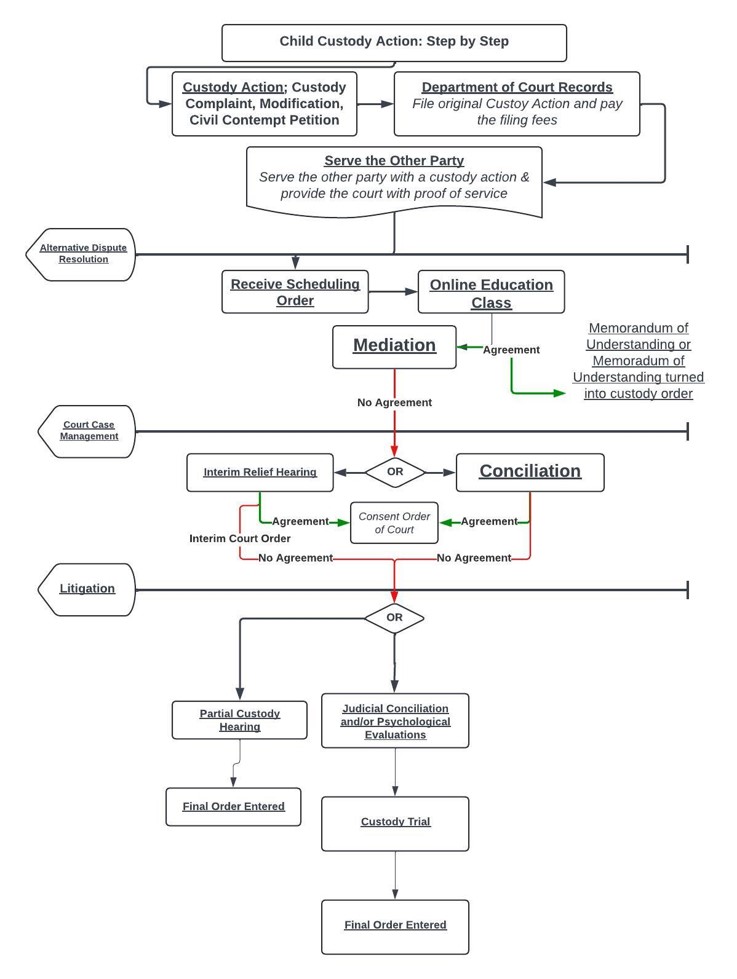
1. Start the Custody Action
To begin, you must file one of the following with the Department of Court Records:
- Custody Complaint
- Custody Modification
- Civil Contempt Petition
All required filing fees must be paid.
After filing, you must serve the other party with the custody action and provide the court with proof of service.
2. Alternative Dispute Resolution Stage
Scheduling and Required Class
After the case is filed and service is completed, the court will issue a Scheduling Order.
All parties must also complete the Online Education Class.
Mediation
The parties then participate in Mediation.
- If the parties reach an agreement:
A Memorandum of Understanding (or a Memorandum of Understanding that is converted into a custody order) is created.
The process ends here. - If the parties do not reach an agreement:
The case moves on to Court Case Management.
3. Court Case Management Stage
The case will proceed through one of the following:
A. Interim Relief Hearing
- If agreement is reached:
The court issues a Consent Order of Court. - If no agreement is reached:
The court may issue an Interim Court Order, and the case continues to litigation.
B. Conciliation
- If agreement is reached:
The court issues a Consent Order of Court. - If no agreement is reached:
The case continues to litigation.
4. Litigation Stage
Once in litigation, the case may proceed in one of two ways:
A. Partial Custody Hearing
A hearing is held, and the court enters a Final Order.
B. Judicial Conciliation and/or Psychological Evaluations
These may lead to a Custody Trial, after which the court enters a Final Order.
Where to Get Help and How to Access Your Case Documents
Self-represented/pro se litigants can seek assistance regarding family legal matters through the Legal Services Clinic that is staffed by Thomas R. Kline School of Law of Duquesne University and University of Pittsburgh School of Law. The staff there may be able to provide limited legal services for free if you qualify. For more information Click Here
Accessing your Custody case documents with the Department of Court Records:
- You may obtain a COPY of court orders/documents that have been filed under your case number with the Department of Court Records in person OR via their website
- In person:
- Monday – Friday 8:30am – 4:30pm,
- City-County Building
414 Grant Street, First Floor
Pittsburgh, PA 15219-2469
- Online:
- In person: